It's A Profession: Cherry Jones To Make Broadway Return
Those rose-colored "glasses" being worn in the poster for the upcoming Broadway revival of
Mrs. Warren's Profession not only work in terms of how the title character's daughter initially views her mother, but also how I'm at least momentarily viewing
Roundabout Theatre Company.
Not only are they bringing
my personal favorite show I saw anywhere last year to Broadway, but they're also responsible for enticing
Cherry Jones back to the Great White Way.
As the titular character in
Mrs. Warren's Profession, Jones finally makes her overdue return to Broadway in
Doug Hughes' revival of the
George Bernard Shaw work. The play centers on the lengths one mother goes toward keep her daughter comfortable, including one well-kept secret. Roundabout
describes the play as follows:
Tony Award winner Cherry Jones returns to Broadway in George Bernard Shaw’s scorching tour de force! Mrs. Warren’s Profession tells the story of Kitty Warren, a mother who makes a terrible sacrifice for her daughter Vivie’s independence. The clash of these two strong-willed but culturally constrained women is the spark that ignites the ironic wit of one of Shaw's greatest plays.
Jones will be joined by
Sally Hawkins as her daughter Vivie,
Edward Hibbert as Mr. Praed,
Adam Driver as Frank Gardner,
Mark Harelik as Sir George Crofts and
Michael Siberry as the Reverend Samuel Gardner.
Hughes' revival marks the sixth time
Mrs. Warren's Profession has been mounted on Broadway.
Written in 1893, it wasn't until 1905 that the play was
first produced on the Great White Way. Due to its highly controversial subject matter (at the time), it was essentially shut down after just one performance when the cast and crew were arrested by the police. The play was
revived in 1907 for 25 performances, then again
briefly in 1918 and
once more for another 25 performances in 1922. Actress
Mary Shaw starred as Kitty Warren for each of those four earliest incarnations.
Then, the play lay dormant, at least on the Great White Way, for over fifty more years before
it was revived at
Lincoln Center in 1976.
Gerald Freedman directed a stellar cast, including
Ruth Gordon as Kitty,
Lynn Redgrave as Vivie,
Edward Herrmann as Frank,
Philip Bosco as George and
Milo O'Shea as the Reverend. While the revival would only play 55 regular performances, it earned Tony nominations for both Herrmann and Redgrave (Herrmann would win for Best Featured Actor).
My only previous experience with this work was back in 2003 at the
Guthrie in Minneapolis. Fortunately, I was well-armed with their excellent
study guide, which I strongly recommend reading only
after you see the performance. It certainly increased my understanding of and overall enjoyment for what was once a truly groundbreaking work.
Previews for
Mrs. Warren's Profession begin at the
American Airlines Theatre on September 3, with opening night slated for one month later on October 3. The brief run is slated to conclude on November 28, 2010.
This is
Steve On Broadway (SOB).
In keeping with the new Federal Trade Commission (FTC) regulations that unfairly discriminate against bloggers, who are now required by law to disclose when they have received anything of value they might write about, please note that I have received nothing of value in exchange for this post.Labels: Cherry Jones, Doug Hughes, First Word On New Show, George Bernard Shaw, Mrs. Warren's Profession, Play, Revival, Roundabout Theatre, Sally Hawkins
 Anything Goes To Stephen Sondheim
UPDATED September 30, 2010
Anything Goes To Stephen Sondheim
UPDATED September 30, 2010
Earlier today,
Roundabout Theatre Company announced that
Kathleen Marshall's upcoming Broadway revival of
Cole Porter's classic musical
Anything Goes would be staged at its newly rechristened
Stephen Sondheim Theatre.
As previously announced,
Sutton Foster will star as Reno Sweeney.
Joel Grey will portray Moonface Martin, it was announced on September 30. The rest of the cast is yet to be announced.
In addition to using the revised 1987 book from
Timothy Crouse and
John Weidman, this mounting of
Anything Goes will be produced in its full glory,
according to Roundabout's Artistic Director
Todd Haimes. (Is Haimes taking a cue from frequent criticism that too many recent Broadway revivals have been whittled down to chamber pieces that are spare on the orchestrations?)
Anything Goes made its Great White Way debut at the
Alvin Theatre (now the Neil Simon Theatre) on November 21, 1934. With original libretto written by
Guy Bolton and
P.G. Wodehouse.
Ethel Merman triumphantly led its titanic cast of more than 60 (which included a little known actress named
Vivian Vance, who'd later find fame as Ethel Mertz on "I Love Lucy"). The production would close nearly one year later on November 16, 1935, after 420 performances.
The
first and only Broadway revival of
Anything Goes was mounted in 1987 by Lincoln Center at its
Vivian Beaumont Theater. Using Crouse and Weidman's revived book, the show starred
Patti LuPone as Reno opposite
Howard McGillin as Billy Crocker, along with the late
Bill McCutcheon as Moonface Martin and
Anthony Heald as Lord Evelyn Oakleigh. Together, they would earn four of this revival's 10 Tony nominations. In addition to McCutcheon scoring a win, the revival won three Tonys, including for Best Revival. The revival of
Anything Goes lasted nearly twice as long as the original, closing on September 3, 1989, after 784 performances.
Will today's audiences get a similar kick out of the upcoming revival? With one of Porter's best scores, count me among those hoping it's positively delovely.
Previews begin on March 10, 2010, with opening night set for April 7.
This is Steve On Broadway (SOB).
In keeping with the new Federal Trade Commission (FTC) regulations that unfairly discriminate against bloggers, who are now required by law to disclose when they have received anything of value they might write about, please note that I have received nothing of value in exchange for this post.Labels: Anything Goes, Broadway, Cole Porter, First Word On New Show, Kathleen Marshall, Musical, Revival, Roundabout Theatre, Sutton Foster
 After Miss Julie (The SOB Review) - American Airlines Theatre, Roundabout Theatre Company, New York, New York*1/2 (out of ****)
On paper, it must have seemed like a complete no-brainer.
Cast the fetching
Sienna Miller in the title role of
Patrick Marber's
After Miss Julie as a sexy, sultry seductress. It doesn't seem like much of a stretch. After all, Ms. Miller's acting prowess has been largely obscured by her more notorious one in both tempting men and her way right into tabloid fodder.
While it's often said that playwrights should write what they know, Ms. Miller should act what she understands. Instead, as the woman of privilege who seduces her father's valet John (
Johnny Lee Miller, who deserves a better Broadway debut than this), she comes up all thumbs, resulting in my own opposable ones appropriately pointing in a decidedly downward direction.
In this clash of power -- class vs. sexual -- you'd think Ms. Miller would be at ease with both. But in a display that is far too shrill, it's really unfathomable that John, who has watched this Julie from an early age, could possibly feel anything for her. He already knows what a screwy coquette she can be, so the sparks between the unrelated Millers seem manufactured.
Making matters worse is that as directed by
Mark Brokaw, Marber's adaptation of
August Strindberg 19th century work transposes the "action" to the kitchen of a large country estate outside of London on the evening of July 26, 1945. I use the term "action" loosely as virtually all of the action really occurs off stage in rooms unseen.
That includes a reception room where a party is taking place the very night the Labour Party wins its first independent majority over Winston Churchill's Conservatives. It's also where Julie demands John dance with her, twice, much to his embarrassment and chagrin.
Also unseen is a bedroom where Julie and John ultimately consummate their lust for one another, only to be found by his intended fiancée and household cook Christine (
Marin Ireland, who acquits herself as well as can be expected).
All this inaction in
Allen Moyer's beautifully appointed kitchen -- with hoots and hollering coming from Julie's party dancing display and Christine's tearful discovery coming from the door of the bedroom, not to mention the unseen crowds offering their derision from outside the kitchen window -- makes for one of the most interminable 90 minutes I've yet to spend in a theatre.
Simply put, I couldn't wait until
after After Miss Julie.
This is Steve On Broadway (SOB).
Labels: After Miss Julie, Broadway, Johnny Lee Miller, Marin Ireland, Mark Brokaw, Patrick Marber, Play, Roundabout Theatre, Sienna Miller, The SOB Review
 After Three Miss Julies Comes After Miss Julie
You'd be forgiven for thinking that the
Mark Brokaw-helmed
After Miss Julie was yet another in a steady stream of
Roundabout revivals the nonprofit theatre company routinely mounts on Broadway. You'd be a tad bit wrong.
Currently in previews at the
American Airlines Theatre, this "new" play stars
Sienna Miller in the titular role alongside
Jonny Lee Miller and
Marin Ireland.
While
August Strindberg's 1888 Swedish play
Miss Julie certainly serves as the source material, this newer
Donmar Warehouse import written by
Patrick Marber takes place in London during the heady summer of 1945, shortly after the conclusion of World War II.
Roundabout describes the play as follows:
She was the girl with everything ... except him. Sienna Miller ("Factory Girl") and Jonny Lee Miller ("Trainspotting") make their Broadway debuts in this provocative American premiere.
Patrick Marber's new version of August Strindberg's drama about class and sex transposes Miss Julie to the English countryside on the eve of the Labour Party's landslide victory in the summer of 1945. Young Miss Julie crosses a dangerous line when she engages in a forbidden flirtation with her father's handsome chauffeur, John.
Over the course of one passionate and unforgettable night, their steamy affair escalates into a high-stakes power struggle that takes a shocking turn. Tony Award nominee Marin Ireland (reasons to be pretty) stars as John's intended, Christine, and Mark Brokaw directs.
Miss Julie has had many lives in many different forms. Even that 2003 Donmar production of
After Miss Julie in London was populated with a completely different cast (
Kelly Reilly, who earned a 2004 Olivier Award nomination for Best Actress, along with
Richard Coyle and
Helen Baxendale) and helmed by a different director (
Michael Grandage).
The first Broadway production of Strindberg's play in 1913 was only subtitled as
Miss Julie. Produced as
Countess Julie at the
48th Street Theatre, the
Mary Shaw-directed work lasted a mere three performances.
Rising from its ashes over 40 years later in 1956 at Rialto's
Phoenix Theatre as
Miss Julie And The Stronger, the
George Tabori-helmed revival lasted a bit longer: 33 performances. This incarnation was actually two Strindberg works playing in repertory.
Viveca Lindfors was cast in the eponymous role and appeared in both plays, as did
Ruth Ford and
Jamie Smith. Acting great
James Daly -- father to both
Tyne and
Timothy Daly -- portrayed the role of Jean in
Miss Julie.
The next time
Miss Julie paid a Main Stem visit was in 1962 at the
Cort Theatre. Once again, the Strindberg play only managed to eke out just three performances. It's understandable considering that it was not only playing in repertory with
The Father and
Long Day's Journey Into Night, but all three plays were performed as originally written ... entirely
in Swedish!
Inge Tidblad held the title role, along with
Irma Christenson as Kristin and
Ulf Palme as
Jean.
Given the rather bizarre track record of previous incarnations, does Marber's fresh take on Strindberg's original play have what it takes to make audiences sit up and take notice? Perhaps with the estimable Mark Brokaw at the helm, along with the eye-popping cast, Roundabout may very well have a steamy winner.
After Miss Julie is currently scheduled as a limited run through December 6, 2009. I'll be taking in the show just a day or so after its October 22 opening and will post my SOB Review then.
This is Steve On Broadway (SOB).
Labels: Broadway, Marin Ireland, Play, Roundabout Theatre
 Roundabout Theatre/Studio 54: Beguiled Yet Again
What is it with
Roundabout Theatre's
Studio 54 that makes essential parts of the theatregoing experience so needlessly unpleasant? Perhaps I mustn't kick it around, but seems I could write a book.
As
regular readers may recall, my February visit to Studio 54 had me paying full price for Row B Orchestra seats
outside of the sightlines. The ushers in their little den of iniquity could have cared less.
My latest outrage occurred just this past Sunday afternoon, when after waiting and waiting
and waiting for the line for right mezzanine seats to physically place me inside the actual theatre space (that
alone took nearly 15 minutes), I then learned that they had run out of
Playbills. Zip.
"Run out of Playbills?" I asked the befuddled usher.
"Yes, they didn't print enough for us," was her response.
Bothered and bewildered, I went downstairs at intermission. One Studio 54 hand told me I could buy a souvenir program. Right. Maybe in the United Kingdom, but not on my beloved Broadway. Yet.
In truth, no one seemed to care. Certainly nobody bothered to say, "I'm sorry."
As it turned out, I found a discarded Playbill upon exiting the theatre and scooped it up.
What do I care for a Playbill? Well, I realize times are tough on Broadway, but for a
theatre aficionado like me, Playbills are essential to the overarching experience. In this case, not only would I have been able to tell who's who in the production or the crew responsible for my enjoyment of the show itself, but I would also have been able to share a private chuckle over this month's unfortunate feature story on
Christian Hoff, who had been set to star in
Pal Joey, but has since been replaced by
Matthew Risch. Playbills are forever.
Shame on the Roundabout for not having the foresight to have a requisite number of these keepsakes on hand.
If you're attending tonight's performance, I just hope that they've received a new shipment, or else you're out of luck in figuring out the cast and crew. Talk about doing it the hard way.
This is Steve On Broadway (SOB).
Labels: Christian Hoff, Matthew Risch, Pal Joey, Playbill, Roundabout Theatre, Studio 54
 Did Critics Offer Saintly Reviews for All Of "Man"?
Last evening, the
Doug Hughes-helmed revival
Robert Bolt's
A Man For All Seasons opened at the
Roundabout Theatre Company's
American Airlines Theatre.
Frank Langella stars as
Sir Thomas More in the moral face-off with
Patrick Page's King Henry VIII. This marked the first Broadway revival of the work since the
1961 original.
Critics' response -- particularly from Ben Brantley, Linda Winer and Joe Dziemianowicz -- indicates that something has been lost, quite literally, since the premiere mounting.
While ceding that it's "not always the most compelling drama,"
USA Today's
Elysa Gardner strikes a positive note via her three out of four star review: "Luckily, this production — like the screen adaptation, which starred
Paul Scofield -- is anchored by an indelible, irresistible performance. As More, Frank Langella ... tackles a very different historical figure with similar grace and depth.... Langella has a worthy sparring partner in
Zach Grenier, who brings bracing menace to the role of Thomas Cromwell, the rival statesman who slavishly and ruthlessly serves the interests of the king."
Concluding that "it's less the production and more its star that best deserves the title of
A Man for All Seasons,"
Frank Scheck provides the
New York Post's three-out-of-four star review that somehow mixes up who's directing (where
is Clive???): "While its theme of individual conscience clashing with the demands of the state remains all too relevant, the drama is a somewhat static, talky affair that is only intermittently compelling. Fortunately, Langella is so mesmerizing in the lead role that he single-handedly overcomes the evening's more tedious passages.... [H]e's deeply moving in the final scenes, when Sir Thomas becomes despairingly aware that his cause is lost. The acting in director
Daniel Sullivan's production for the Roundabout Theatre Company -- which wisely eschews the Common Man character which originally served as the play's narrator -- is otherwise less impressive.
Noting how "the play is a star vehicle disguised as ensemble drama,"
Variety's
David Rooney is nevertheless largely laudatory:
"The 1961 drama ... is not without windy preachiness. But the Roundabout staging becomes more gripping as it proceeds, driven by a performance from Frank Langella as measured and naturalistic as it is majestic.... By denying the man more than a flicker of doubt or remorse over the consequences of his actions, and by drawing adversaries that outwit him with cunning but never with intellect, the playwright robs the drama of texture.... Langella's performance, however, is sufficiently commanding to overcome the role's limited dimension. The actor's effortless authority is softened by a playful sense of irony that makes it seem only natural he would toss off a cutting remark even while being sentenced to die."
Pondering whether it's "heresy to whisper that the sainted Thomas More is a bit of a bore,"
The New York Times'
Ben Brantley Mr. Langella says that this
Man isn't suited for the current season: "Mr. Langella haloes himself with such incandescence that you may wish you had brought along a pair of polarized glasses. But starlight needs to flicker and sputter if a complex character is to emerge from all that radiance. And Mr. Bolt’s script ... neglects to include several essential ingredients for a compelling dramatic hero. Like conflict, doubt, vacillation and change.... But it is evident as well why there had been no Broadway revival of the play for four decades."
While revering Langella's big stature, but lamenting, "It's the plays that got small,"
Newsday's Nora Desmond, er,
Linda Winer echoes Brantley: "The texture of Robert Bolt's 16th century English-chronicle drama has been flattened by director Doug Hughes' decision (with permission from the estate) to cut the role of the Common Man. He is missed.... On the other hand, the disappearance of the Common Man does offer an uncluttered view of Langella. His More, for all his self-destructive conscience, is excellent company, just the sort of elegantly intelligent force who believes that 'God made man to serve him wittily.' By wit, he means alertness, not humor, and Langella -- in court favor and as a doomed prisoner -- suggests the plush yet wary presence of someone stroking a cat."
Lamenting how the "parched Roundabout revival all too seldom ignites,"
Joe Dziemianowicz of New York's
Daily News provides just two-and-a-half stars out of five: "Doug Hughes seems at a loss for fresh ways to make Bolt's wordy warhorse feel urgent as it plays out over 2 1/2 hours on
Santo Loquasto's skeletal set of Tudor-style timbers and shifting panels. In one noteworthy move, Hughes has deleted the Common Man, a character who comments on the action.... Langella gives a characteristically intelligent and sensitive performance, but while we see More's plight, we don't feel it -- largely a result of Bolt's script."
This is Steve On Broadway (SOB).
Labels: A Man For All Seasons, Broadway, Critics' Capsule, Doug Hughes, Frank Langella, Play, Revival, Roundabout Theatre
 A Man For Broadway's 2008-09 Season Opens Tonight
This evening, the very first Broadway revival of
Robert Bolt's
A Man For All Seasons opens at the
Roundabout Theatre Company's
American Airlines Theatre.
Helmed by
Doug Hughes, the revival stars three-time Tony Award winner
Frank Langella as
Sir Thomas More. Langella faces
Patrick Page as King Henry VIII.
The late, great
Paul Scofield not only earned a Tony Award for his portrayal of More in the original
1961 Broadway play, but he also won an Academy Award in the
Best Picture of 1966.
Will critics see this as a play for all ages (epochal periods, that is)? Find out tomorrow as I provide my critics' capsule.
This is Steve On Broadway (SOB).
Labels: A Man For All Seasons, Doug Hughes, Frank Langella, Patrick Page, Paul Scofield, Play, Revival, Roundabout Theatre
 Broadway Preview: A Man For All Seasons
Less than a half year after the
passing of
Paul Scofield -- the actor's actor will long be remembered for his Tony and Academy Award-winning portrayals of
Sir Thomas More in the
1961 Broadway stage and
1966 film productions, respectively, of
A Man For All Seasons -- a new
Doug Hughes-helmed Main Stem
revival is slated to begin preview performances at the
Roundabout Theatre Company's
American Airlines Theatre on September 12.
Opening night is scheduled for October 7. The limited engagement will run through November 30.
This first revival of
Robert Bolt's
A Man For All Seasons will be headlined by three-time Tony Award winner
Frank Langella as the
English Chancellor who famously defied
King Henry VIII by standing up for his beliefs. This will be Langella's first Great White Way turn since his Tony-winning performance last year as another historical figure,
Richard Nixon, in
Frost/Nixon.
The original Rialto production opened on November 21, 1961, and was honored with four Tony Awards, including Best Play, Best Actor (Scofield) and Best Direction (
Noel Willman). That mounting of
A Man For All Seasons enjoyed a run of 637 performances before closing June 1, 1963.
Given Langella's propensity for earning critical accolades and theatre honors, expect
A Man For All Seasons to be a hot ticket. Tickets go on sale for American Express cardholders on July 16; for everyone else, August 1.
This is Steve On Broadway (SOB).
Related Stories:Broadway Preview: To Be Or Not To Be (July 2, 2008)
Broadway Preview: The Seagull (July 1, 2008)
Broadway Preview: Equus (June 30, 2008)
Broadway Preview: A Tale Of Two Cities (June 28, 2008)
Broadway Preview: for colored girls who have considered suicide when the rainbow is enuf (June 25, 2008)
Broadway Preview: [title of show] (June 24, 2008)
Broadway: What's Next (June 20, 2008)
Paul Scofield - RIP (March 20, 2008)
Labels: A Man For All Seasons, Doug Hughes, First Word On New Show, Frank Langella, Frost/Nixon, Paul Scofield, Play, Revival, Roundabout Theatre
 How Safe Did Critics Feel Dangereuses Revival Played It?
Last evening, the first Broadway revival of
Christopher Hampton's
Les Liaisons Dangereuses opened at the
Roundabout Theatre Company's
American Airlines Theatre.
Headlined by
Laura Linney and
Ben Daniels, the play is helmed by British director
Rufus Norris. Other cast members include
Jessica Collins,
Mamie Gummer and
Siân Phillips.
Critical reaction was mixed. All seemed to enjoy Daniels' Rialto debut.
Concluding that "the game remains eminently well worth watching,"
New York Post's
Clive Barnes awards this production three out of four stars: "As revived last night by the Roundabout, Christopher Hampton's play is sensual, oddly naughty and totally, impassively immoral. That sensuality is neatly caught by Rufus Norris' elegantly paced staging and the leads: the couthly chilly Laura Linney, as La Marquise de Merteuil, and a splendiferous Ben Daniels, enjoyably snakelike as the urbane Le Vicomte de Valmont.... [T]he sheer joyous relish he takes in a wickedness he can't stop, even when his happiness and life depend on it, is horrifically convincing. Rather less convincing is Linney's unbroken hauteur as the vengeful, conniving Marquise."
Calling the revival "naughty, provocative fun,"
Elysa Gardner of
USA Today also offers a three star review: "The stars of this revival ... are worthy inheritors. Linney portrays the impervious elegance of a certain type of society woman as ably as (Glenn) Close did. But Linney also transmits an inescapable warmth, making the Marquise's ability to disarm her victims completely convincing, while giving us scrupulously subtle glimpses of her enduring ardor for Valmont. The witty Daniels, in contrast, seems impenetrable, at least until we grasp the full extent of Valmont's feelings for the virtuous Madame de Tourvel, whose honor he intends to destroy for reasons more complicated than he realizes. When forced to confront his love for this married woman, and how he has hurt her, Daniels powerfully evokes his ravaging guilt and regret."
Hailing this as a "sturdy and stylish revival,"
Joe Dziemianowicz of New York's
Daily News gives the production three out of five stars: "Laura Linney steps into the role and delivers a mesmerizing performance as she all but disappears into pre-revolutionary France of the 1780s.... British actor Ben Daniels is bold and lusty ... as the ravenous Valmont.... Director Rufus Norris ... keeps the intricate plot lines flowing, and his smart use of music (servants double as singers) adds texture and commentary."
Noting how "this delicious tournament of sex and power never gets old,"
Variety's
David Rooney says the production "proves resilient -- despite some heavy-handed directorial choices and one crucial piece of miscasting.... Norris initially appears to put a starchy stamp on the material, allowing dead air to punctuate the dialogue. But this is soon revealed to be a choice tailored in particular around Linney's approach to Merteuil.... At first it seems she's not having enough fun with the role's lip-smacking villainy, but her attitude makes sense for a woman who has parlayed her impenetrable detachment and knack for listening into a supreme art.... The big problem in the drama's central triumvirate is the object of that love. Collins is sorely inadequate and unaffecting as Madame de Tourvel.... Grace, piety and vulnerability -- all are lacking in Collins' work here...."
Lauding a "sensational Broadway debut,"
Ben Brantley of
The New York Times is charmed by at least one of the leads: "Mr. Daniels provides both the silliest and most serious rendering I’ve seen of Valmont.... His warm, fluid performance reflects what would appear to be Mr. Norris’s intention: to turn up the temperature in a work of famously icy cynicism. Unfortunately no one else in this revival approaches Mr. Daniels’s level of complexity, including Ms. Linney, a wonderful actress who has been shoehorned into a part out of her natural range and is perceptibly pinched.... Here she is required to wear a mask of hypocrisy, and it doesn’t fit."
Lamenting that the show "eventually proves numbing,"
Eric Grode of
The New York Sun takes aim at the icey chill be saw in the production : "It's as if Ms. Linney worked so hard to squelch her innate warmth, with the British import Mr. Daniels following suit, that the brittle badinage and machinations are all that remain.... Mr. Norris ... emphasizes the endless connivings between this pair to the exclusion of any of the rawer, less epigrammatic emotions that accompany Valmont's ostensible upheaval. These two have become so numbed to the possibility of actual romantic love that their increasingly fraught rendezvous are reduced to mere pique. No matter how alluring Mr. Daniels's cocktail of preening vanity and disingenuous sensitivity becomes, this unwillingness to honor at least the possibility of emotional transcendence robs this
Liaisons of a crucial layer of humanity."
I'll be taking in the production myself over the next few days and will offer my own SOB Review shortly thereafter. This limited run production is scheduled through June 29.
This is Steve On Broadway (SOB).
Click here for tickets.Related Stories:Les Liaisons Dangereuses' Latest Broadway Affair Opens (May 1, 2008)
The 1,400 Steps (March 17, 2008)
Labels: Ben Daniels, Broadway, Christopher Hampton, Critics' Capsule, Laura Linney, Les Liaisons Dangereuses, Play, Revival, Roundabout Theatre, Rufus Norris
 Les Liaisons Dangereuses' Latest Broadway Affair Opens
This evening, the first Great White Way revival of
Christopher Hampton's
Les Liaisons Dangereuses opens at the
Roundabout Theatre Company's
American Airlines Theatre.
Under
Rufus Norris' guiding hand, this incarnation stars
Laura Linney as La Marquise de Merteuil opposite
Ben Daniels as Le Vicomte de Valmont. This marks Linney's first Rialto turn since 2004's
Sight Unseen for which she received a Tony nomination.
Other notable cast members in
Les Liaisons Dangereuses include
Mamie Gummer (daughter of
Meryl Streep) as Cécile Volanges,
Siân Phillips as Madame de Rosemonde, and
Jessica Collins as La Présidente de Tourvel.
Les Liaisons Dangereuses originally appeared on Broadway's
Music Box Theatre 21 years ago, when the
Howard Davies-helmed production enjoyed a 149 performance run along with 7 Tony nominations, including for Best Play. That incarnation starred Tony nominees
Lindsay Duncan and
Alan Rickman.
Subsequently, the play was turned into the highly acclaimed 1988 film "
Dangerous Liaisons," boasting what would now have to be deemed as nothing less than an all-star cast with
Glenn Close,
John Malkovich,
Michelle Pfeiffer,
Swoosie Kurtz,
Keanu Reeves,
Mildred Natwick and
Uma Thurman. Christopher Hampton earned an Academy Award for his screen adaptation.
So with all the previous success of Hampton's material, will this revival safely glide to critical praise? Find out tomorrow as I provide my critics' capsule.
This is Steve On Broadway (SOB).
Click here for tickets.Related Stories:The 1,400 Steps (March 17, 2008)
Labels: Ben Daniels, Broadway, Christopher Hampton, Laura Linney, Les Liaisons Dangereuses, Opening Night, Play, Revival, Roundabout Theatre, Rufus Norris
 The 39 Steps (The SOB Review) - American Airlines Theatre, Roundabout Theatre Company, New York, NY*** (out of ****)
How far is it from Winnipeg to Montreal?
A
whole lot farther than 39 steps.
But there's just a few short degrees between super silly and supercilious, and yet the satire in
The 39 Steps more than ably straddles the line -- along with bridges, the tops of trains, etc. -- making it, measure by measure, an inspired comic delight.
Through
Maria Aitken's creative direction and
Patrick Barlow's innovative adaptation (based on an original concept by
Simon Corble and
Nobby Dimon),
The 39 Steps gains incredible mileage from its rather wan source material, the
1935 film by
Alfred Hitchcock.
On that note, I must confess that as much as I'm a fan of many of the great director's works, I had never seen this one -- until about two months ago. That was after I learned that a stage adaptation of Hitchcock's flick "The 39 Steps" would be heading across the Atlantic (the play continues its healthy London run at the West End's
Criterion Theatre after winning last year's Olivier Award for Best New Comedy). Not only did this leap toward the top of my list of must-see shows, but it also required me to make a visit to my nearby video store to rent the original film.
Boy, am I glad I did, not necessarily because I think the film is particularly great -- it's now unintentionally laughable and a bit of a bore -- but it essentially informed and significantly enhanced my personal enjoyment of the stage send-up, providing me an understanding of the underlying plot points. What Aitken, Barlow & Co. have created is a hilariously inventive parody with a nearly line-by-line, frame-by-funny-frame finesse of one of Hitchcock's trademark wrong man in the wrong place at the wrong time themes.
In this case, after a
femme fatale is murdered in his London apartment, Canadian Richard Hanney (a charming
Charles Edwards) finds himself embroiled in the middle of a clandestine conspiracy stretching from London to Scotland and back to steal away state secrets. En route, Hanney encounters scores of characters, yet the show's conceit is that they're all portrayed by just three marvelously industrious actors, who never skip a beat:
Arnie Burton,
Jennifer Ferrin and
Cliff Saunders.
In fact, most of the show's heavy-lifting is accomplished by Burton and Saunders, whose inexhaustible energy would give a certain
battery bunny a run for its money. As if a spy thriller needed any additional "thrill," these two certainly offer exhilarating performances that will take your breath away.
The 39 Steps also brilliantly sends-up at least a half dozen other Hitchcock flicks, seemlessly weaving them into the plot, thanks to the deceptively simple, yet ingenious staging (with credit going to
Peter McKintosh for set and costumes,
Kevin Adams' lighting and
Mic Pool's sound design).
If the show stumbles at all, it's when it veers from the movie's familiar territory, specifically with its heavy-handed First Act touch that identifies the enemy as the Nazis (something the film never did). At this point, the piece becomes a bit labored. This is also one show that is ill-served by an intermission, which impedes the flow of what could accomplished in a little over 100 minutes.
Still, right down to a well-timed cameo by the maestro of suspense himself,
The 39 Steps stands as an inspired homage to Alfred Hitchcock. But remember that a prior screening of the original film will serve as step in the right direction.
This is Steve On Broadway (SOB).
Click here for tickets.Related Stories:Did 39 Steps Benefit From Critical Leap? (January 16, 2008)
"39" Steps Into Broadway Opening (January 15, 2008)
39 Steps To The Great White Way (September 6, 2007)
Sunday At The Grosvenor House With Laurence (February 19, 2007)
Labels: Arnie Burton, Broadway, Charles Edwards, Cliff Saunders, Film, Jennifer Ferrin, Marian Aitken, Play, Roundabout Theatre, The 39 Steps, The SOB Review
 Saturday Afternoon In Studio 54 With Bad Seats
Regular readers
will know that when it comes to theatre seats, I prefer to be up close and personal with the stage, so when it comes to buying tickets, I'm usually pleased when an opportunity to purchase Row B seats pop up.
Dear readers will also recall that I offered a
very favorable review of the Broadway revival of
Sunday In The Park With George.
Great show.
Pity about the seats.
When I arrived at
Studio 54 a week ago Saturday, I had that rush of adreneline I get when the usher directs me to the front of the theatre. But when my party of three reached our seats in Row B (seats 7, 9 and 11), we realized that two of the three of us were literally outside the sightlines for the left hand side of the stage. Never mind that we paid
exactly the same price as those with prime center orchestra seats.
There was so much jostling and complaining --
by the people in seats B 3 and 5 -- that they eventually got reseated in the center. Since all this occurred literally right before the show began, the three of us had little choice but to stay put. However, we each moved over two positions.
Now, I realize that the
Roundabout Theatre Company is a not-for-profit operation, but to charge the
same price for these terrible seats and
without any warning that the view is obstructed is just this side of criminal.
So,
caveat emptor to anyone who's purchasing tickets to this wonderful show. If you're offered seats near the front on the sides, either ask what discount you'll receive or flatly refuse. Otherwise, you'll walk away feeling as cheated as I did.
And that's no Sunday in the park!
This is Steve On Broadway (SOB).
Click here for tickets.Related Stories:Sunday In The Park With George (The SOB Review) (February 22, 2008)
Ever Had A Front Row Seat? (October 1, 2008)
Labels: Broadway, Roundabout Theatre, Studio 54, Sunday In The Park With George, Theatre Seating
 Did Critics Offer Praise At New Sunday Revival?
Last evening, director
Sam Buntrock's British import revival of
Stephen Sondheim and
James Lapine's musical
Sunday In The Park With George opened at
Roundabout Theatre Company's
Studio 54. The cast of the musical includes
Daniel Evans as George/George,
Jenna Russell as Dot/Marie,
Michael Cumpsty,
Jessica Molaskey,
Mary Beth Peil,
Ed Dixon,
Anne L. Nathan and
Alexander Gemignani.
After having earned
five Olivier Awards exactly a year ago last Monday, were Broadway critics similarly impressed with the show? The answer is a qualified "yes."
Positively gushing in her four-star review,
USA Today's
Elysa Gardner lauds: "[Y]oung British director/animator Sam Buntrock has managed to use technology to enhance the bittersweet beauty of one of that era's most substantive musicals...The superb Daniel Evans makes clear the generational distinctions between the Georges while linking their obsessive, narcissistic tendencies, and making them sympathetic nonetheless. Jenna Russell, a sassy, sensual Dot, is funny, touching and completely convincing as the 98-year-old but still-wily Marie. Buntrock also culls lovely supporting performances from Michael Cumpsty, Jessica Molaskey, Mary Beth Peil and others."
Proclaiming the show "an experience to be savored,"
David Rooney of
Variety sings
Sunday's praises: "Daniel Evans brings moving intensity and a febrile punctiliousness that's almost painful to watch as both 19th-century French Neo-Impressionist painter
Georges Seurat and his great-grandson George, a contemporary American multimedia artist. As his aptly named mistress, Dot, and later as her elderly emigre daughter Marie, Jenna Russell is incandescent....From the first flashes of light that accompany Sondheim's opening chords -- as a charcoal stroke slashes the back wall of designer
David Farley's ingenious blank-canvas, skewed-perspective set and details are rapidly sketched in by
Timothy Bird's
CGI projections -- there's an absolute assurance and thrilling synthesis of creative vision in evidence here."
Labeling this an "elegantly acted, directed and designed revival,"
Joe Dziemianowicz of New York's
Daily News is similarly enthused: "The excellent Daniel Evans and Jenna Russell reprise their West End roles. Evans brings fiery intensity to each George, but is never mannered. As Dot, Seurat's muse and mistress, and her daughter Marie, Russell draws you in with radiant warmth....Buntrock, a young British up-and-comer, isn't just concerned with 'Gee whiz' effects. His sharp and graceful staging awakens the beauty in the exhilarating score and makes weaknesses in the story -- Act II restates what's already been said in Act I -- fade."
Deeming the production a "glorious revival,"
The New YorkTimes'
Ben Brantley offers a positive review: "The great gift of this production, first staged in London two years ago, is its quiet insistence that looking is the art by which all people shape their lives. As a consequence, a familiar show shimmers with a new humanity and clarity that make theatergoers see it with virgin eyes. And while
Sunday remains a lopsided piece -- pairing a near-perfect, self-contained first act with a lumpier, less assured second half -- this production goes further than any I’ve seen in justifying the second act’s existence.... And Mr. Buntrock’s
Sunday, which also stars a charming Jenna Russell as Dot, has the same intimacy it possessed when I saw an earlier version at the tiny
Menier Chocolate Factory in London in 2005."
Initiating her review with a reassuring, "Fear not. It's still magic,"
Newsday's
Linda Winer offers a mostly favorable assessment: "Whatever the differences -- a few even better, a few not -- this new
Sunday is heart-thumpingly true to the mother lode....The result is a work of art about the making of art, an intimate piece of effortless musical audacity -- and a great bittersweet love story -- that remains among the peak theater experiences of my life....Ultimately, this is nothing less than an unpretentious art-history lesson, a thoughtfully conservative message about the need for order in art. It is also a close-to-the-bone consideration of art's toll on a human being, an inspirational message about the need for people to connect and to move on."
Urging readers to take in the show's "unmissably innovative piece of musical staging,"
New York Post's
Clive Barnes offers three stars: "The results, built into the designs by David Farley and the lighting by
Ken Billington, and based on pointillist Georges Seurat's iconic painting, "
Sunday Afternoon on the Island of Grande Jatte," is one of the most visually amazing shows ever to reach Broadway. So far as geek wizardry goes, Buntrock and his team of animators, led by Timothy Bird, have possibly reinvented the Broadway wheel.... So far, so good. Then almost total collapse. The second act -- set in 1984 -- unfortunately finds George's great-grandson in the modish American art world, fighting for the patrons and subsidies to finance his own clearly pretentious style of visual art. The story now drifts off into highfalutin fatuity....Clever, but the act is also boring and pompous."
Allowing that this revival is "accomplished enough," Bloomberg's
John Simon delivers perhaps the most sour note: "The James Lapine book is extremely clever, Stephen Sondheim's score even more so. Unfortunately, clever and good are not quite identical.... I found the
original 1984 Broadway production, with scenery by
Tony Straiges and orchestrations by
Michael Starobin, slightly more compelling than this revival....My real problem, finally, is that the songs, though generally impressive, are more apt than appealing, more concert hall than Broadway. It is a musical with rather more mind than heart."
With all the critical raves, even
from me, could this
Sunday In The Park With George possibly be granted an extension beyond June 1? Stay tuned.
This is Steve On Broadway (SOB).
Click here for tickets.
Related Stories:
Sunday In The Park With George (The SOB Review) (February 22, 2008)
Sunday Opens Thursday Night (February 21, 2008)
Show Deals: Breaking The Code (February 10, 2008)
Looking Forward: The SOB Top Five (January 2, 2008)
Sunday In The Park With Daniel And Jenna (May 7, 2007)
"Sunday" In Studio 54 With Roundabout (February 23, 2007)
Is It Just Me, Or...(Part II) (February 21, 2007)
Sunday At The Grosvenor House With Laurence (February 19, 2007)
Which British Hits Will Be Broadway-Bound? (September 20, 2006)
Sunday in the Park With George Revival Opens in London's West End (May 23, 2006)
Labels: Broadway, Critics' Capsule, Daniel Evans, James Lapine, Jenna Russell, Mary Beth Piel, Musical, Revival, Roundabout Theatre, Sam Buntrock, Stephen Sondheim, Sunday In The Park With George
 Sunday In The Park With George (The SOB Review) – Roundabout Theatre Company, Studio 54, New York, NY
***1/2 (out of ****)Art isn't easy.
But in the hands of director
Sam Buntrock, an exquisite theatrical masterpiece literally comes to life, bit by dazzling bit, in the stunning revival of
Stephen Sondheim and
James Lapine's
Sunday In The Park With George.
In the first Broadway revival of this classic, now playing in the
Roundabout Theatre Company's
Studio 54 -- a less than optimum venue for the production, which I'll get into another time -- Buntrock's ingenious staging begins with a blank canvas, courtesy of
David Farley's colorless set design, effectively awash in white lighting by
Ken Billington.
But before long, the canvas takes on a life of its own, and it isn't simply because all of its inhabitants (played by a stellar cast) are suddenly abounding with vitality. Here, every minor detail is a major decision.
When Buntrock first staged this show in 2006 at London's tiny
Menier Chocolate Factory, necessity really became the show's mother of invention. Strapped for cash, Buntrock turned to
Tim Bird and
The Knifedge Creative Network to fill in the blanks with an enthralling, radiant projection design that is unequivocally the true star of this musical, making it a gorgeous work of art worthy of a great master.

And speaking of such a master,
Sunday In The Park With George is, of course, a fictionalized account of the painstaking, lonely artistic process undertaken by neo-impressionist
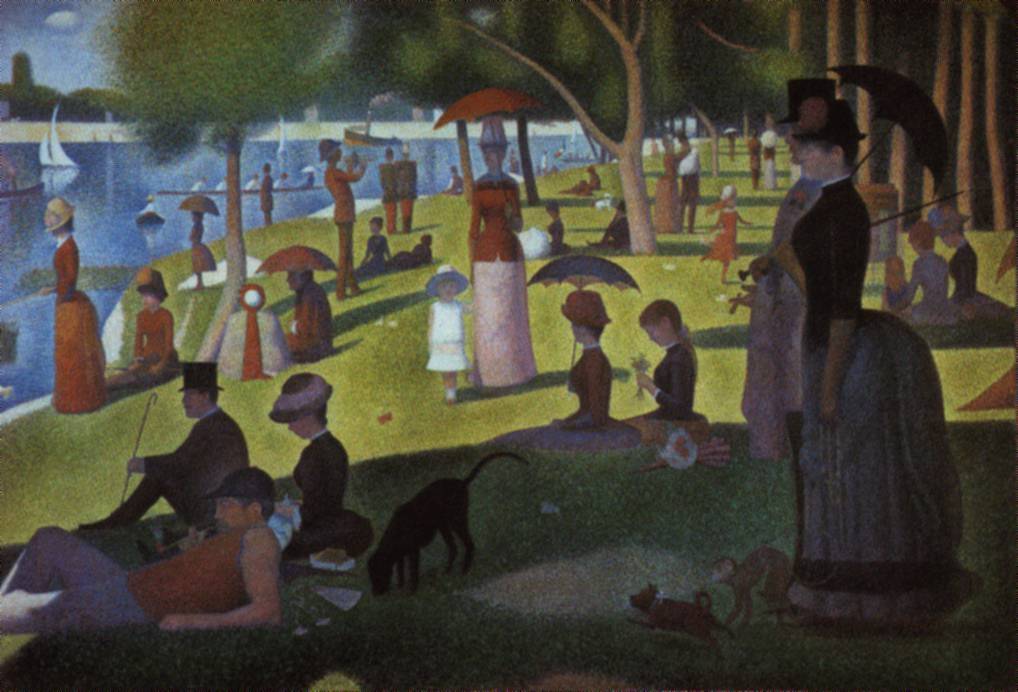
Georges-Pierre Seurat in creating his pointillistic painting "
Sunday Afternoon on the Island of Grande Jatte." While the photo above doesn't do it justice, Seurat relied on the right light to blend different colors together, placing perhaps little hues of blue among slight dabs of red to make it appear violet from afar.
The fictionalized aspects of this musical focus on George's interaction, or lack thereof, with each of the subjects in the painting.
Daniel Evans imbues his George with all the manic, single-minded discipline one would expect from a dedicated artist, whether it's his accentuated devotion to "Color And Light":
Red red red red
Red red orange
Red red orange
Orange pick up blue
Pick up red
Pick up orange
From the blue-green blue-green
Blue-green circle
On the violet diagonal
or his becoming so absorbed in the world he's creating that he prefers it to the real thing -- a place that includes his long-neglected mother (
Mary Beth Peil) and Dot, played by an astounding
Jenna Russell in an impish, yet heartbreaking performance as George's simple-minded and attention-starved muse.
The artist seemingly remains unmoved, even after learning that he's fathered Marie, a child bound for America. In fact, the moment that moved me the most was watching the clammy white, luminescent Piel sitting stoically in a haunting display of dignified sorrow as her son steals away her chance to know her only grandchild -- ironic given the incredibly enduring relationship between the George of Act Two and his own Grandmother Marie, who was the same baby that had been stolen away to America.
The first act climaxes with the entire production's pièce de résistance, an apex in which George puts it all together in a brilliant and touching finish as the actors recreate the famous work of art.
It may sound like I'm quibbling here, but the show's second act doesn't quite, well, connect. While still engrossing, it doesn't quite provide the intense kind of emotional tug I'd expected as Marie's grandson George faces many of the same challenges as his supposed great grandfather. Yet it's during this act that Sondheim's memorable score wins the day and eventually helps elevate it to a glorious conclusion.
As
noted at the beginning of the year,
Sunday In The Park With George was one of the top five stage productions I most eagerly anticipated for 2008. While I missed it in London, it was certainly well worth the wait to finally see what is unmistakably a great piece of art.
Sunday In The Park With George is scheduled to run at Studio 54 through June 1.
This is Steve On Broadway (SOB).
Click here for tickets.Related Stories:Sunday Opens Thursday Night (February 21, 2008)
Show Deals: Breaking The Code (February 10, 2008)
Looking Forward: The SOB Top Five (January 2, 2008)
Sunday In The Park With Daniel And Jenna (May 7, 2007)
"Sunday" In Studio 54 With Roundabout (February 23, 2007)
Is It Just Me, Or...(Part II) (February 21, 2007)
Sunday At The Grosvenor House With Laurence (February 19, 2007)
Which British Hits Will Be Broadway-Bound? (September 20, 2006)
Sunday in the Park With George Revival Opens in London's West End (May 23, 2006)
Labels: Broadway, Daniel Evans, James Lapine, Jenna Russell, Mary Beth Piel, Musical, Revival, Roundabout Theatre, Sam Buntrock, Stephen Sondheim, Sunday In The Park With George, The SOB Review
 Sunday Opens Thursday Night
This evening, the first full-blown Broadway revival
Stephen Sondheim and
James Lapine's musical
Sunday In The Park With George opens at Roundabout Theatre Company's
Studio 54 under the direction of
Sam Buntrock.
It was Buntrock who in 2006 famously brought the tuner back to life in the fledgling little London theatre known as the
Menier Chocolate Factory, prior to it being whisked away to the West End. There, it dominated the Olivier Awards a year ago Monday, winning five awards, including for Outstanding Musical Production, Best Actor in a Musical (
Daniel Evans) and Best Actress in a Musical (
Jenna Russell).
Now, Buntrock has brought Evans and Russell stateside to cast their spell on the Great White Way's landscape in the first real revival of the beloved show about the labor of love and art.
The cast features many Broadway veterans like
Michael Cumpsty,
Jessica Molaskey,
Mary Beth Peil and
Ed Dixon, along with a couple who know their way around Sondheim revivals:
Anne L. Nathan (Emma Goldman in
Assassins),
Alexander Gemignani (John Hinkley in
Assassins and Beadle in
Sweeney Todd).
The
first Broadway production of
Sunday In The Park With George played the
Booth Theatre for a total of 604 performances, opening on May 2, 1984. Directed by Lapine, the show starred
Mandy Patinkin as George/George and
Bernadette Peters as Dot/Marie. While that
Sunday would fail to win any major Tony Awards (winning only Best Scenic Design for
Tony Straiges and Best Lighting Design for
Richard Nelson), losing out to the year's big winner
La Cage Aux Folles, it would go on to win the Pulitzer Prize for Drama.
Here's a taste of irony. Menier is now restaging
La Cage Aux Folles in a sold-out run starring
Douglas Hodge, one of Russell's co-stars from the recent London hit revival of
Guys And Dolls. How's that for putting it together, bit by sweet delicious bit?
With all eyes now focused squarely on Studio 54, will Buntrock's magic be heralded anew? Find out tomorrow as I not only provide my critics' capsule, but also my own SOB Review.
This is Steve On Broadway (SOB).
Click here for tickets.Related Stories:Show Deals: Breaking The Code (February 10, 2008)
Looking Forward: The SOB Top Five (January 2, 2008)
Sunday In The Park With Daniel And Jenna (May 7, 2007)
"Sunday" In Studio 54 With Roundabout (February 23, 2007)
Is It Just Me, Or...(Part II) (February 21, 2007)
Sunday At The Grosvenor House With Laurence (February 19, 2007)
Which British Hits Will Be Broadway-Bound? (September 20, 2006)
Sunday in the Park With George Revival Opens in London's West End (May 23, 2006)
Labels: Broadway, Daniel Evans, James Lapine, Jenna Russell, Menier Chocolate Factory, Musical, Opening Night, Revival, Roundabout Theatre, Sam Buntrock, Stephen Sondheim, Sunday In The Park With George
 Did 39 Steps Benefit From Critical Leap?
Last evening,
Patrick Barlow's stage adaptation (from an original concept by
Simon Corble and
Nobby Dimon) of the
Alfred Hitchcock film
The 39 Steps opened at
Roundabout Theatre Company's
American Airlines Theatre. Directed by
Maria Aitken,
The 39 Steps stars
Arnie Burton,
Charles Edwards,
Jennifer Ferrin and
Cliff Saunders.
Most critics offered solid positive reviews.
Complimenting the show, seriously, as "[T]hrowaway theater at its finest,"
The New York Times'
Ben Brantley "But the appeal here is ultimately more to theater aficionados than to movie buffs, and you don’t need to have seen the movie to appreciate the accomplishment of the show. Ms. Aitken and company are using their cinematic template to celebrate the art of instant illusion-making that is theater. Much of the show’s pleasure comes from being in on the magician’s tricks even as, on some primitive level, you accept them....The actors themselves seem to be having a helluva good time. As does the audience. For in addition to providing the relief of being committedly silly in a season of fine dramas about unhappy families,
The 39 Steps stands out for its plying of minimal resources to maximal effect."
Calling the comedy "inventively astonishing,"
New York Post's
Clive Barnes offers a three-star review: "The resultant play is a marvelous spoof of the movie, translating Hitchcock's thrills, spills and visuals into elementary stage effects....The play's creators have affectionately pushed Hitchcock's brilliance...into some riotous realm of satire, without losing its essentially Hitchcockian flavor. Aitken, though ultimately in charge of all the fun and games, is much indebted to her actors -- Edwards, Ferrin and her two protean clowns, Burton and Saunders."
Exulting it as "a dizzy delight,"
Joe Dziemianowicz of New York's
Daily News was dazzled: "It's great fun to watch classic Hitchcock scenes come alive through nothing more than simple props and theatrical magic. A high-speed chase aboard a whizzing train is brilliantly re-created with four crates, puffs of smoke, flashing lights and actors game for anything....The production is inventively directed by Maria Aitken....If
The 39 Steps makes a misstep, it's having an intermission. Once this fast-paced fun ride leaves the station, you don't want to get off."
Labeling
The 39 Steps as "eccentric" and "an interesting diversion,"
David Rooney of
Variety: "The central joke in this frenetic spoof is the utter unsuitability of the material -- with its high-speed chases across moors, rivers, an elevated bridge and the roof of a moving train -- for stage presentation. The dated conventions of '30s filmmaking, the outmoded acting styles, preposterous accents and the loopy dialogue played straight all combine with a tongue-in-cheek performance mode that blends mime, slapstick and Monty Python-esque drollery in a brand of film sendup that's more commonly the domain of television, from
'The Carol Burnett Show' to
'French & Saunders.'"
Deriding the show as a "strenuously silly parody,"
The New York Sun's
Eric Grode was left cold by the production: "[D]espite Maria Aitken's agreeably antic staging and the Herculean efforts of her four hardworking actors, Mr. Barlow pads his scene-by-scene homage with overly obvious references to other Hitchcock films, and sight gags that don't go much of anywhere....But while these four actors may be ready for their close-ups, their sketch-comedy shenanigans are only sporadically ready for prime time."
The limited run of
The 39 Steps is currently slated until March 29. I'll be seeing the show over the next month and will let you know what I think.
This is Steve On Broadway (SOB).
Click here for tickets.Related Stories:"39" Steps Into Broadway Opening (January 15, 2008)
39 Steps To The Great White Way (September 6, 2007)
Sunday At The Grosvenor House With Laurence (February 19, 2007)
Labels: Broadway, Critics' Capsule, Film, London, Marian Aitken, Play, Roundabout Theatre, The 39 Steps
 "39" Steps Into Broadway Opening
First, it was an early
Alfred Hitchcock film that was known for "putting the
man in romance." (The 1935 flick starred
Robert Donat and
Madeleine Carroll, as well as a very young
Peggy Ashcroft.)
Then, several generations later, it became a West End sensation, winning last year's
Olivier Award for Best New Comedy. (The official wording on the prize was "
John Buchan's
The 39 Steps adapted by
Patrick Barlow from an original concept by
Simon Corble and
Nobby Dimon at the Criterion.")
Now, this evening,
The 39 Steps opens at
Roundabout Theatre Company's
American Airlines Theatre for a limited run through March 29.
The show is described by Roundabout as:
...a hilarious whodunit, part spy thriller and part slapstick comedy, adapted for the stage from the famous film and novel.
And it's all done with a mere four cast members --
Arnie Burton,
Charles Edwards,
Jennifer Ferrin and
Cliff Saunders -- portraying a variety of roles.
I'll be taking in a performance in the weeks to come, so no SOB Review just yet. But I'll provide my critics' capsule tomorrow.
This is Steve On Broadway (SOB).
Click here for tickets.Related Stories:39 Steps To The Great White Way (September 6, 2007)
Sunday At The Grosvenor House With Laurence (February 19, 2007)
Labels: Broadway, Film, London, Marian Aitken, Opening Night, Play, Roundabout Theatre, The 39 Steps
 Hello Birdie?
According to
Liz Smith in
Variety,
Bye Bye Birdie may be headed toward a Broadway revival. Smith gushes in her column that "
Charles Strouse says he'll bring his all-American musical
Bye Bye Birdie back to the
Roundabout!"
The tuner with book by
Michael Stewart and score by
Lee Adams and Strouse has never before been revived on the Great White Way.
Its one and only run began April 14, 1960 and ran for 607 performances. The original production garnered eight Tony nominations including for Best Musical, as well as for Best Featured Actor in a Musical,
Dick Van Dyke, who was catapulted to superstar status.
Chita Rivera received her first of nine Tony nominations for her work. Van Dyke and Rivera reunited during the run of her
Chita Rivera: The Dancer's Life to relive a bit of
Birdie when they sang "Put On A Happy Face."
Although a revival has never made it to Broadway, there was an attempt to bring back
Birdie via the ill-fated 1981 sequel
Bring Back Birdie that closed on Broadway after just four regular performances. Not even Chita Rivera's star power could keep that open, but she did manage a Tony nod yet again.
My only experience in ever seeing
Bye Bye Birdie in its entirety was through a high school production when I was just a kid (my sister portrayed one of the swooning teens).
This is Steve On Broadway (SOB).
Labels: Bye Bye Birdie, Charles Strouse, Chita Rivera, Dick Van Dyke, First Word On New Show, Musical, Revival, Roundabout Theatre
 Did Pygmalion Suffer From Critically Great Deigns?
The first revival in twenty years of
George Bernard Shaw's classic
Pygmalion opened last night at Broadway's
American Airlines Theatre. Reviews were decidedly mixed as some critics could have dissed all night.
Proclaiming that it "has plenty of class,"
Joe Dziemianowicz of New York's
Daily News offers one of the most positive reviews: "[B]y George, it's always compelling and often delicious, even if it does feel a tad claustrophobic.
Claire Danes, making her stage debut as Eliza Doolittle, beams confidence as the Cockney flower girl made into a society lady. Funny and feisty, she turns a scene in which Eliza makes polite conversation about the weather into something with gale-force hilarity....Mays plays the part as a prickly mama's boy prone to tantrums and bad behavior. It's daring. And it works....
Pygmalion all but sings without any music. I could have watched all night."
Dazzled by the "beguiling time" he had,
Michael Sommers of Newark's
Star Ledger is similarly positive: "[I]t's a pleasure to see how nicely the 95-year-old play can still tickle viewers in
Roundabout's first-class revival, which opened yesterday at American Airlines Theatre. The subject for Shaw's social satire -- the superficial nature of class distinctions -- is long outdated. Yet his 1912 story about the unlikely association of a phonetics expert with a Cockney flower girl remains entertaining....Making a lovely Broadway debut, Claire Danes ably traces the heroine's flowering from a 'quashed cabbage leaf' of Covent Garden into a cultivated beauty who enchants an embassy party. Initially performing with a Cockney yowl that sounds as authentic as her later elegant tones -- as well as a consistently graceful physicality -- Danes is a spirited yet sensitive Eliza."
Saying this
Pygmalion is "enjoyable enough," Bloomberg's
John Simon is mostly upbeat: "This being a comedy of manners and ideas, as well as a period piece and British, it requires a good deal from American actors, yet, by George (or Bernard), it pretty much gets it. Only in one place does it fall down seriously: in the casting of
Jefferson Mays as Higgins....There is, however, compensation in a very pleasant surprise: the Eliza of movie actress Claire Danes, who, contrary to preceding malevolent rumors, is a marvelous heroine....She even achieves that elegantly elongated English-rose look."
Despite his awe for the "dazzling Claire Danes"
New York Post's
Clive Barnes gives the show two stars: "
David Grindley's sober, somber, dark reading of the text, joined by
Jonathan Fensom's meager sets and costumes and
Jason Taylor's dimmish lighting, does the playwright few favors....Jefferson Mays, who plays Higgins here, seems more like a shopkeeper than a professor. He is shrill, abrasive and totally sexless."
Citing what he calls a "mothbally, duty-bound heft,"
Eric Grode of the
New York Sun mostly pans: "Mr. Grindley likes to give audiences something to chew on — even choke on — as they leave the theater. And
Pygmalion has always encouraged a director's impulse to tinker, particularly in its final moments....This newly melancholy interpretation runs completely afoul of Shaw's printed directions, and yet it could be psychologically defensible....Mr. Grindley has fallen prey to the frequent habit of defanging Colonel Pickering, Higgins's genteel but only marginally less thoughtless co-conspirator; the poised decency that comes so naturally to
Boyd Gaines actually diminishes the role slightly....Ms. Danes lacks the tonal versatility to rise above this static conception of the role."
Linda Winer of
Newsday laments: "(Danes) has done herself no favors by making her stage debut as Eliza Doolittle....She likes to lunge during excited moments, but her pounce always seems a beat off the narrative....We appreciate Mays' determination to escape the shadow of
Rex Harrison by re-imagining Higgins as a far less dashing fellow. But Mays turns him into a
Richie Rich of a mama's boy, a busy and obnoxious twit with crazy eyes and exaggerated nervous habits, whose feet don't touch the floor when he sits on tables, which he does a lot. Of course, despite the happy end in
My Fair Lady, Shaw never meant this to be a romantic comedy. But without any chemical buzz between teacher and student, Grindley's decision to tack a sentimental spasm on Shaw's clear-eyed final moment feels especially contrived."
Calling it a "misfired revival,"
Ben Brantley of
The New York Times apparently was hoping to dance all night, failing to remember that this non-musical was not about love: "For there is not a whisper of mutual attraction between this production’s Eliza and Henry....(Danes') game, conscientious portrayal doesn’t make much of an impression here. The main event, the performance that’s most likely to provoke heated after-theater discussion, is Mr. Mays’s epicene Henry Higgins. Looking like a cross between the 1930s child star
Freddie Bartholomew and
Nathan Lane at his most impish, the smooth-faced Mr. Mays shatters the cranky-but-sexy mold of Henry Higginses past....Maybe I’m just one of those sentimental fools Shaw held in such contempt."
Well of course you are, Mr. Brantley! At least you hold no pretense about
that.
For the record, I liked it much more than many of the critics.
This is Steve On Broadway (SOB).
Click here for tickets.Related Stories:Pygamalion (The SOB Review) (October 19, 2007)
Come What Mays, My Fair Danes Opens Tonight (October 18, 2007)
Pygmalion Revival: There Is Nothing Like A Danes? (July 10, 2007)
Labels: Boyd Gaines, Broadway, Claire Danes, Critics' Capsule, George Bernard Shaw, Jefferson Mays, Play, Pygmalion, Revival, Roundabout Theatre