The Intelligent Homosexual's Guide To Capitalism And Socialism With A Key To The Scriptures (The SOB Review)
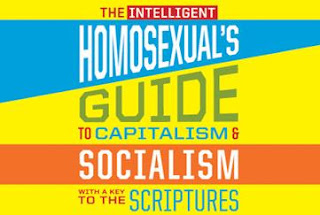 The Intelligent Homosexual's Guide To Capitalism And Socialism With A Key To The Scriptures (The SOB Review) - McGuire Proscenium Stage, Guthrie, Minneapolis, Minnesota
**1/2 (out of ****)
Last evening, Tony Kushner's The Intelligent Homosexual's Guide To Capitalism And Socialism With A Key To The Scriptures enjoyed its world premiere at the Guthrie in Minneapolis.
Whew! Simply writing that is exhausting. Just try sitting through this three and a half hour plus production as it clearly remains a work in progress, despite director Michael Greif's best efforts to rein it in immediately prior its official opening. It's been reported that just three days ago, the estimable ensemble was still working on script before preview audiences.
If you're anticipating the kind of profound sweeping social statement that verbose playwright Tony Kushner provided through the groundbreaking Angels In America or the level of compelling social history he offered via Caroline, Or Change, you may just find yourself a little disappointed. The title of the play seems to suggest a latter-day "gay fantasia on national themes" as his Angels works had been dubbed. While Kushner inhabits Intelligent Homosexual with five gay characters -- none of whom, with the possible exception of one, are particularly likeable -- they remain on the periphery of the central plot. Nevertheless, Kushner manages to offer quite a screed.
If you're then wondering where that unusual title comes from, it's derived from two unlikely 19th Century sources: playwright George Bernard Shaw's 1928 book "The Intelligent Woman's Guide to Socialism, Capitalism, Sovietism and Fascism" and Christian Science founder Mary Baker Eddy's 1875 tome "Science and Health with Key to the Scriptures." The program for this play includes Kushner's notes from "Waking Up" (1997), which embellishes on those themes:
The Intelligent Homosexual ... I have been observing him all my life. He is busy with his life's work, a massive book running to many volumes entitled The Intelligent Homosexual's Guide To Socialism And Capitalism, With A Key To The Scriptures. He has been writing this book, day after day, for forty years; since parturition he's been writing it. He knows it to be incompleteable, he knows he will die writing it, he knows he is working himself to death -- though he does not want to die.As the ultimate observer, Kushner has swept those themes and so much more into his play about an unlikely intellectual retiree named Gus Marcantonio, intensely portrayed here by the seemingly fearless Tony Award and Pulitzer Prize-winning playwright Michael Cristofer. Having toiled a lifetime not only as a longshoreman, but also an ardent Communist, Gus possesses a philosophy on life at odds with his 2007 Brooklyn setting.
The play begins in earnest as Gus' sister Bennie (played with subtle grace by Kathleen Chalfant) and his three adult children -- Maria Teresa or M.T. (as in "Empty"-- get it? because if you don't it will be underscored for you) (Linda Emond), Pier or "Pill" (Stephen Spinella) and Vito (Ron Menzel) --reunite at their family home. This house was initially shared with other families and stayed with the Marcantonios even through the Great Depression. As the housing bubble ballooned during the early part of this decade, the brownstone was worth a considerable fortune by 2007.
Gus not only sees the economic storm clouds gathering, but he realizes that it might not be long before the bubble is about to burst and the home's value will begin to plummet. Claiming he has Alzheimer's, Gus gathers his brood to announce two last acts of benevolence. He plans to sell the home while it can earn top dollar, and he will kill himself so that his family will reap an early inheritance and avoid suffering through the indignities that come from his scourge.
Add to that mix a couple of self-loathing gay characters. Provocative themes to be sure. However, Kushner excessively leans on histrionics to make his points. A few too many of his characters bloviate and pontificate ad nauseum on everything from religion to far left politics with an almost fascist ferocity that ironically defies some of the very themes against which the playwright seems to be throwing down his gauntlet. Can there really be that many intellectuals emanating from one blue collar household? It all sounds so, well, labored and forced.
Even more frustrating is the largely unintelligible second of three acts, in which family members squabble at length, including a few highly-charged and raw shouting matches. What is remarkably unfortunate is that rather than allowing each heated argument to play out on its own, Greif appears to have opted to layer them on top of one another in an apparent gambit to winnow down the show's running time. The result is nothing short of a cacophonic mess. No wonder Gus' daughter interrupts the din to call her family nightmarish.
While I've been reading that Kushner's third act is not quite the equal of the first two, I'd argue the opposite. Kushner uses his third act to passionately make his underlying case for connectedness, and he does so with a degree of clarity and pathos only hinted at during the first two acts.
As I said, this is clearly an evolving work. No doubt, Kushner will continue refining The Intelligent Homosexual. Yet given what he's written about it back in 1997, one can't help but fear he'll be doing so the rest of his life.
This is Steve On Broadway (SOB).
Labels: Michael Greif, Minneapolis/St. Paul, Play, The Intelligent Homosexual's Guide To Capitalism And Socialism, The SOB Review, Tony Kushner
posted by Steve On Broadway (SOB) @ Saturday, May 23, 2009
10 comments


